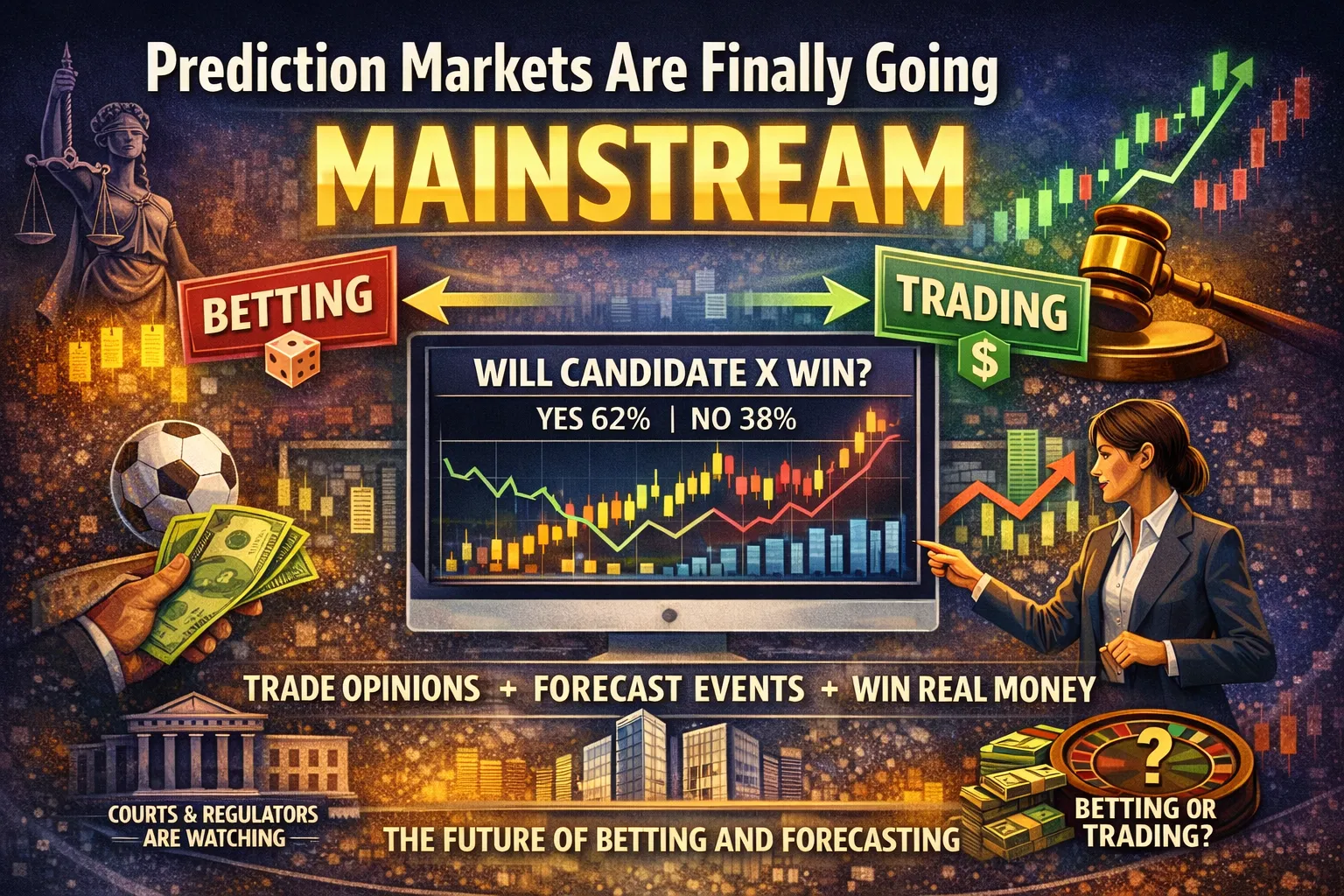
For decades, prediction markets lived at the edge of finance and academia. They were experimental, lightly regulated, and often dismissed as gambling dressed up in economic theory. Traders on platforms such as Intrade, PredictIt, and the Iowa Electronic Markets could buy contracts on elections, economic data, and world events, but the broader public rarely paid attention. That era is over. Prediction markets have gone mainstream, and the shift is reshaping how investors, media companies, corporations, and ordinary people think about forecasting.
The rise of Polymarket, Kalshi, and similar platforms has pushed event contracts into the center of public conversation. Elections, interest rate decisions, sports outcomes, entertainment awards, and geopolitical crises are now traded like assets. Prices on these markets are quoted in newspapers, cited by analysts, and watched by hedge funds. What was once a niche tool for economists is becoming a real-time information layer for the global economy.
This article explores why prediction markets are entering the mainstream, how they work, who the major players are, what risks they create, and what the future may hold. It also examines whether the mainstreaming of prediction markets will improve public knowledge or simply turn every event into a speculative casino.
What Are Prediction Markets?
Prediction markets are exchanges where participants trade contracts whose value depends on the outcome of a future event. A contract might pay $1 if a certain candidate wins an election and $0 if they lose. If the contract trades at $0.65, the market is implying a 65% probability that the event will occur. Traders buy and sell based on their beliefs, news, data, and intuition. The resulting price becomes a crowd-sourced forecast.
The core idea is simple: when people put money behind their opinions, they tend to be more careful, more analytical, and more honest. Unlike polls, which ask people what they think, prediction markets ask people what they are willing to risk. That financial skin in the game can reveal information that surveys miss.
Prediction markets are not perfect. They can be manipulated, illiquid, or irrational. But in many cases, they have outperformed polls, pundits, and expert panels. Their growing popularity suggests that the public is hungry for alternatives to traditional forecasting.
Why Prediction Markets Are Going Mainstream Now
The mainstreaming of prediction markets did not happen overnight. Several forces converged to push them into the spotlight.
A. Regulatory breakthroughs
In the United States, Kalshi won a landmark court case against the Commodity Futures Trading Commission, allowing it to offer event contracts on political outcomes. That decision opened the door for regulated election betting in a way that had been blocked for years.
B. Crypto infrastructure
Polymarket and other crypto-native platforms use blockchain rails, stablecoins, and decentralized settlement. This allows global users to trade without traditional banking friction, although it also raises regulatory questions.
C. Media amplification
News outlets now regularly cite prediction market odds. When a market moves sharply, it becomes a story. This creates a feedback loop: more coverage brings more users, and more users bring more liquidity.
D. Institutional demand
Hedge funds, proprietary trading firms, and data providers are looking for alternative data. Prediction markets offer a real-time probability feed that can be integrated into trading models and risk dashboards.
E. Retail speculation
The same wave of retail trading that boosted meme stocks, options, and crypto has found a new outlet in event contracts. The interface is simple, the payoff is binary, and the topics are engaging.
F. Political polarization
In a world of competing narratives, prediction markets offer a numeric scoreboard. People may disagree about values, but they can agree on a price. That makes markets attractive to journalists and analysts seeking neutral-seeming signals.
From Fringe to Front Page
The history of prediction markets is a story of repeated breakthroughs and crackdowns. The Iowa Electronic Markets began in 1988 as an academic project. Intrade became popular in the 2000s but was eventually shut down by regulators. PredictIt operated for years under a no-action letter before facing legal challenges. Each time, the industry seemed destined for obscurity.
Then came crypto. Augur, Gnosis, and Polymarket showed that decentralized markets could operate globally. Polymarket gained massive attention during the 2020 and 2024 U.S. elections. Its order books became a public scoreboard for political probability. At the same time, Kalshi pursued a regulated path, arguing that event contracts are a legitimate financial product, not illegal gambling.
The result is a two-track industry: regulated exchanges for U.S. users and crypto-based platforms for global users. Both are growing quickly, and both are forcing regulators to answer difficult questions about what counts as gambling, investing, or information.
Who Are the Main Players?
The prediction market landscape is becoming crowded. Several platforms now compete for liquidity, users, and legitimacy.
A. Kalshi
A CFTC-regulated exchange that offers event contracts on economics, politics, weather, and more. It has positioned itself as the compliant, institutional-friendly option.
B. Polymarket
A crypto-native platform built on Polygon. It gained enormous volume during elections and often leads in political market liquidity. It has faced regulatory scrutiny and geographic restrictions.
C. PredictIt
A longtime academic-style market that became a political betting hub. Its future has been uncertain due to regulatory challenges.
D. ForecastEx
An exchange backed by Interactive Brokers, aimed at institutional and retail traders who want event exposure alongside traditional assets.
E. Crypto exchanges
Platforms such as Binance, Coinbase, and others have explored event contracts, though regulatory concerns have limited their expansion.
F. Traditional financial data providers
Bloomberg, Reuters, and other data terminals now display prediction market odds. This normalizes the idea that event probabilities are financial data.
How Prediction Markets Actually Work
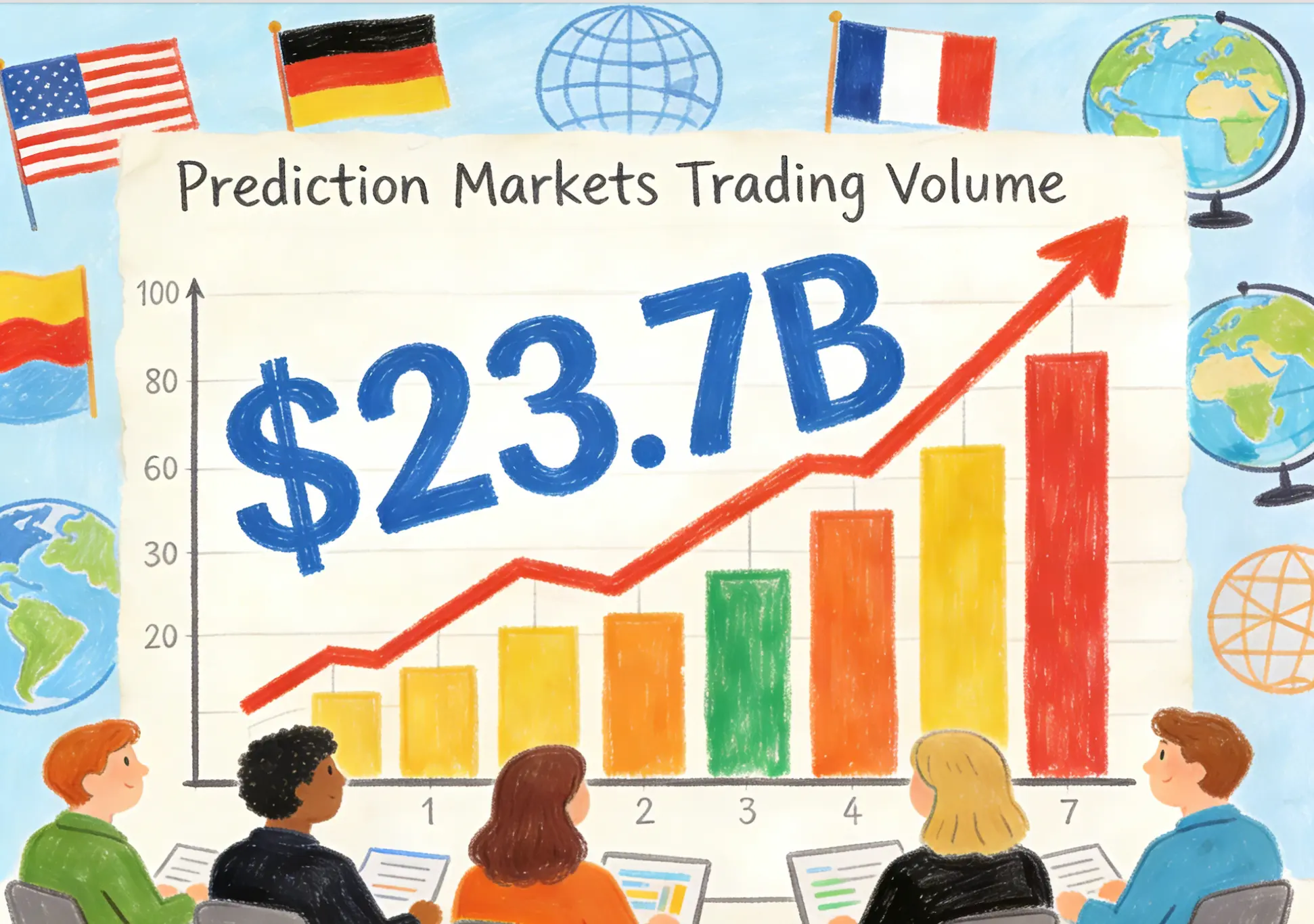
At their core, prediction markets are order-driven exchanges. Buyers and sellers post bids and offers. When they agree, a trade occurs. The contract price reflects the market’s best estimate of probability. When the event resolves, the contract pays out according to the rules.
Key components include:
A. Contract design
Each contract specifies the event, the resolution source, the deadline, and the payout. Ambiguity is the enemy of trust.
B. Liquidity
Without enough traders, prices can be noisy and easily moved. Market makers and arbitrageurs help keep prices efficient.
C. Settlement
Regulated markets use clearinghouses and legal contracts. Crypto markets use smart contracts and oracles.
D. Compliance
KYC, AML, and geographic restrictions are major operational challenges. Regulators want to prevent money laundering, terrorism financing, and gambling without licenses.
E. User experience
The best platforms make complex markets feel as simple as buying a stock. This is a major reason for their growth.
Why Economists Like Prediction Markets
Economists have long argued that markets aggregate information better than any single expert. Friedrich Hayek described markets as a discovery process. Prediction markets extend that logic to future events. They allow dispersed knowledge to be reflected in prices.
Proponents point to several benefits:
A. They reduce reliance on pundits
Television commentators can be wrong for years without consequence. Markets force participants to bear the cost of bad forecasts.
B. They provide real-time updates
When news breaks, prices move instantly. This gives the public a continuous probability estimate.
C. They reward accuracy
Traders who consistently identify mispricing can profit. This attracts skilled analysts and data scientists.
D. They can hedge risk
Businesses can use event contracts to hedge exposure to elections, regulations, or economic data.
E. They can reveal consensus
Even if markets are not always right, they show what the crowd believes at a given moment.
Use Cases Beyond Elections
Election betting dominates headlines, but prediction markets are expanding into many other areas.
A. Economic forecasting
Markets can trade on inflation, interest rates, GDP, and unemployment. These contracts can complement futures and options.
B. Corporate events
Earnings beats, mergers, product launches, and CEO departures can be traded. Companies might use them for internal forecasting.
C. Sports
Sports betting is already massive, but prediction markets offer a different structure: peer-to-peer trading rather than fixed-odds betting.
D. Weather and climate
Contracts on hurricanes, temperatures, and natural disasters can help insurers and farmers hedge risk.
E. Geopolitics
Markets can price the probability of conflicts, treaties, sanctions, and coups. This is controversial but valuable for risk analysts.
F. Entertainment
Oscar winners, box office results, and streaming rankings are natural prediction market topics.
G. Science and technology
Drug approvals, AI milestones, and space missions could become tradable events.
The Risks and Controversies
Mainstreaming brings scrutiny. Prediction markets face serious criticisms.
A. Manipulation
A wealthy trader can move a thin market and create a misleading signal. This is especially dangerous when media outlets report prices as truth.
B. Regulatory arbitrage
Crypto platforms may operate offshore while serving U.S. users. Regulators see this as evasion.
C. Gambling addiction
Binary contracts can be as addictive as sports betting or casino games. Consumer protection is a major concern.
D. National security
Markets on assassinations, wars, or terrorist attacks could incentivize harmful behavior or create public panic.
E. Insider trading
Traders with non-public information may exploit markets. This is illegal in securities, but rules for event contracts are still evolving.
F. Liquidity fragmentation
Too many platforms split liquidity, making prices less reliable.
G. Ethical concerns
Turning elections, disasters, or human suffering into tradable assets can feel morally questionable.
Regulation: The Central Battlefield
Regulation will determine whether prediction markets become a lasting part of finance or a temporary fad. In the United States, the CFTC has jurisdiction over event contracts. The agency has approved some contracts and rejected others, often citing public interest concerns.
The Kalshi case was a turning point. A federal court ruled that the CFTC could not block election contracts without a clear legal basis. That decision forced the agency to reconsider its approach. Still, states may try to regulate prediction markets as gambling, creating a patchwork of rules.
In Europe, regulators are watching closely. The UK has strict gambling laws, and the EU’s MiCA framework focuses on crypto assets rather than event contracts. Asia is mixed: some jurisdictions allow betting, while others ban it entirely.
The likely outcome is a fragmented global market. Regulated platforms will thrive in permissive jurisdictions. Crypto platforms will serve users in gray areas. Enforcement actions will continue.
The Technology Stack Behind the Boom
Prediction markets rely on a complex technology stack. Crypto-native platforms use blockchain for transparency and settlement. Stablecoins provide a dollar-denominated unit of account. Oracles bring external data on-chain. Layer-2 networks reduce fees and increase speed.
Regulated platforms use traditional databases, clearinghouses, and bank transfers. They prioritize compliance over decentralization.
Both models face challenges:
A. Scalability
High fees or slow settlement can kill user experience.
B. Security
Hacks and smart contract bugs can drain funds.
C. Identity
KYC requirements conflict with crypto’s pseudonymous ethos.
D. Data integrity
Resolution sources must be trustworthy. Disputes can destroy confidence.
E. Interoperability
Moving funds between platforms is still difficult.
Institutional Adoption and the Data Economy
The most important shift may not be retail trading but institutional adoption. Hedge funds are already using prediction market data to inform trades. Media companies use odds to frame stories. Corporations may use event contracts to hedge regulatory risk.
In the future, prediction market probabilities could become standard data feeds, like stock prices or bond yields. They could be embedded in dashboards, news apps, and AI models. This would make them part of the information infrastructure of society.
However, institutions need reliable, regulated, and liquid markets. They will not rely on platforms that can be shut down or manipulated. This creates pressure for consolidation and compliance.
Will Mainstreaming Improve Forecasting?
The optimistic case is that more liquidity leads to better accuracy. With more traders, more data, and more arbitrage, prices should become more efficient. Prediction markets could become the world’s best real-time forecasting tool.
The pessimistic case is that mainstreaming brings noise. Meme traders, political partisans, and manipulators could distort prices. Media coverage could create feedback loops that reward drama over accuracy. Markets could become entertainment rather than information.
The truth is likely mixed. Major markets with high liquidity will be relatively efficient. Niche markets will be noisy. Users will need to understand the difference.
Key Challenges Ahead
For prediction markets to become a durable part of finance, several challenges must be addressed.
A. Regulatory clarity
Platforms need clear rules on what is allowed, who can trade, and how disputes are resolved.
B. Consumer protection
Users need warnings, limits, and tools to prevent addiction and fraud.
C. Liquidity incentives
Market makers need reasons to provide tight spreads.
D. Reputation
The industry must distance itself from scammy gambling sites.
E. Integration
Traditional brokers and banks must be able to offer event contracts safely.
F. Global coordination
Without international standards, regulatory arbitrage will persist.
Future Scenarios
How will the prediction market story unfold? Three scenarios are plausible.
A. Bull case
Prediction markets become a standard financial asset class. Regulated exchanges thrive, institutional money flows in, and event probabilities become as common as stock quotes. Forecasting improves, and businesses use markets to manage risk.
B. Bear case
A major scandal, manipulation case, or regulatory crackdown destroys trust. Platforms shut down or retreat to offshore gambling. Mainstream adoption stalls.
C. Base case
Prediction markets remain a niche but growing sector. Elections and sports drive most volume. Regulation remains fragmented. Some platforms become profitable and respected, while others fade away.
Conclusion
Prediction markets have crossed a threshold. They are no longer a fringe experiment. They are quoted in major media, traded by institutions, and regulated by courts. Their rise reflects a broader demand for real-time information in a world of uncertainty.
Yet mainstreaming brings new responsibilities. If prediction markets are to become trusted tools, they must solve problems of manipulation, regulation, liquidity, and ethics. They must prove that they are more than gambling with a fancy name.
The next few years will decide whether prediction markets become a permanent part of the financial system or a passing speculative craze. One thing is certain: the genie is out of the bottle. Event contracts are now part of the conversation, and the world will never look at forecasting the same way again.